

Educate • Protect • Empower Florida Homeowners
Florida Homeowners Insurance Guide
Why Are So Many New Insurance Companies Entering Florida?
If you have shopped for Florida homeowners insurance recently, you may have seen quotes from companies you do not recognize. Some of those companies are traditional insurers. Others may be structured as Reciprocal Insurance Exchanges. This guide explains the difference in plain English.

Singh Insurance Method
We do not just sell policies. We help Florida homeowners understand the market, compare options, and choose coverage with confidence.
Educate
Analyze
Protect
In this guide:
Why unfamiliar insurance companies are showing up in Florida quotes
What a Reciprocal Insurance Exchange is
How reciprocal exchanges differ from traditional insurance companies
What a Subscriber Savings Agreement means
How to evaluate any Florida homeowners insurance company
Questions to ask before switching carriers
You receive a homeowners insurance quote. The premium looks competitive. Your mortgage company may accept it. Your agent says it may be a legitimate option. But the name is unfamiliar, and the natural question is: who exactly is protecting my home?
That question matters. Insurance is one of the largest financial promises a homeowner may ever rely on. When Florida's insurance market changes, homeowners deserve clear explanations—not confusion, fear, or sales pressure.
Florida's Insurance Market Has Changed
Florida's property insurance marketplace has experienced significant change due to storm exposure, rising rebuilding costs, reinsurance pressure, carrier appetite, litigation history, and legislative reforms. As the market changes, new insurance companies and new structures may enter the state to provide additional options for homeowners.
The Florida Office of Insurance Regulation announced on May 20, 2026 that three additional property and casualty insurers were entering Florida's market and stated that 20 companies had entered since historic legislative reforms. The same announcement stated that those new companies had brought more than $850 million in new capital to support additional growth in the state's property market.
Florida Insurance Market: Why Homeowners Are Seeing New Names
Market Stress
Storms • costs • claims
Carrier Pullback
Reduced appetite
Reforms
Market response
New Capacity
New capital enters
More Options
More questions
Singh Insurance helps homeowners understand the company behind the quote.
Custom branded graphic: Florida insurance market timeline.
What Is a Reciprocal Insurance Exchange?
A Reciprocal Insurance Exchange is an insurance structure where policyholders, often called subscribers, participate in an exchange that is managed by a professional organization commonly called an Attorney-in-Fact.
To a homeowner, the experience may feel familiar: the homeowner receives a policy, pays premium, and files claims under the policy contract. The difference is mostly behind the scenes: ownership, management, surplus, and subscriber-related documents.
How a Reciprocal Exchange Works
Homeowner
Needs protection
Subscriber
Joins exchange
Exchange
Shares risk
Attorney-in-Fact
Manages operations
Claims
& operations
The policy may feel familiar. The structure behind the policy is different.
Custom branded graphic: homeowner to subscriber to exchange structure.
How Is a Reciprocal Exchange Different From a Traditional Insurance Company?
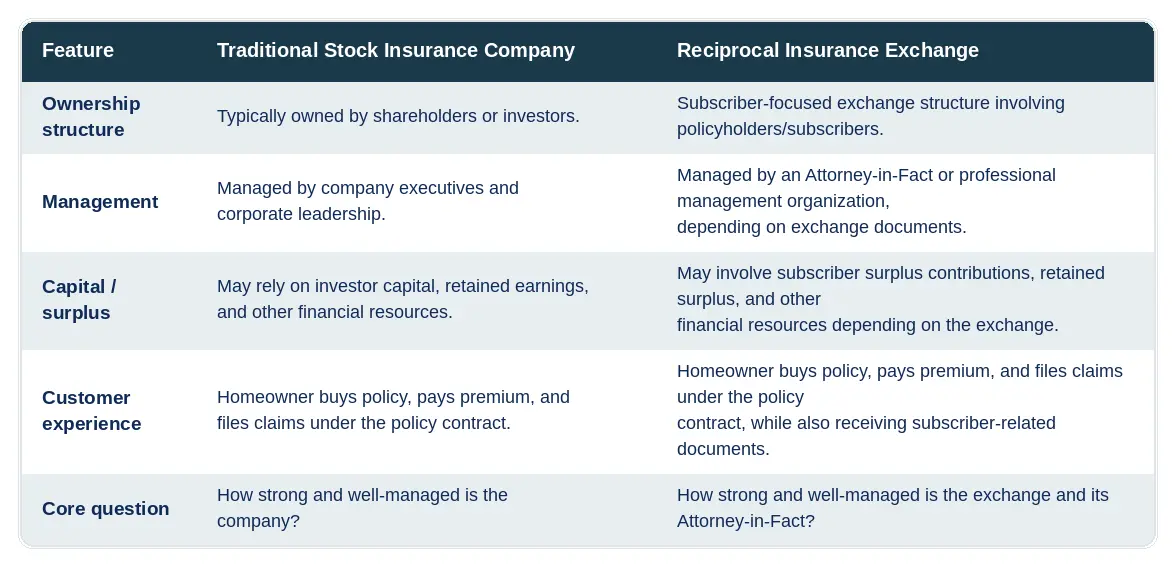
Three Common Insurance Structures
Custom branded graphic: stock company vs. mutual company vs. reciprocal exchange.
What Is a Subscriber Savings Agreement?
One document homeowners may receive with a reciprocal exchange is a Subscriber Savings Agreement, subscriber agreement, or similar document. The name may sound intimidating, but the basic purpose is to explain the homeowner's relationship with the reciprocal exchange.
Depending on the reciprocal exchange, the agreement may address subscriber rights, surplus contributions, governance, how an Attorney-in-Fact manages the exchange, or related terms.
Plain-English point: This document does not automatically mean a policy is good or bad. It means the homeowner should understand the structure and review the specific terms that apply to that policy.
Are Reciprocal Insurance Exchanges Safe?
A reciprocal exchange is not automatically safer or riskier simply because it is a reciprocal exchange. The structure is only one part of the full picture.
When evaluating any Florida homeowners insurance company, homeowners should ask broader questions about financial strength, reinsurance, claims reputation, management experience, policy language, exclusions, endorsements, and deductible structure.
Florida Homeowner Decision Framework
Homeowner
Needs protection
Subscriber
Joins exchange
Exchange
Shares risk
Attorney-in-Fact
Manages operations
Claims
& operations
Price matters. Confidence matters too.
Custom branded graphic: the decision framework homeowners should use before choosing a company.
The Singh Insurance Method
The goal is not to overwhelm homeowners with insurance jargon. The goal is to make the decision easier by breaking complex market changes into clear, practical questions.
The Singh Insurance Method
Educate
Analyze
Recommend
Protect
Advocate
This is how Singh Insurance turns market confusion into client confidence.
Custom branded graphic: the Singh Insurance education-first client experience.
Questions Every Florida Homeowner Should Ask
Is this company a traditional insurance company, mutual company, reciprocal exchange, or another type of insurer?
Who manages the company or exchange?
What financial strength information is available?
What is the company's reinsurance program?
How does the policy compare with my current coverage?
Are there exclusions, limitations, or endorsements I should understand?
What happens if a major hurricane affects Florida?
Why did my agent recommend this carrier for my household?
Michael Singh's Perspective
“A reciprocal exchange is not automatically better or worse than a traditional insurer. It is a different structure. The real job is helping Florida homeowners understand who is making the promise to protect their home, how that organization works, and whether the policy actually fits their situation.”
Frequently Asked Questions
Have Questions About Your Florida Homeowners Insurance?
Whether your current policy is with a traditional insurance company, a mutual company, or a reciprocal exchange, Singh Insurance can help you understand what you have and what questions to ask before making a change.
Suggested downloadable guide
Create a PDF lead magnet titled “10 Questions to Ask Before Switching Florida Homeowners Insurance Companies.” Link it here once published.
Sources and Further Reading
Custom branded graphic: the Singh Insurance education-first client experience.